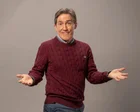
At 61, Rob Brydon has built an extraordinary career on a simple principle: he is, as he puts it, 'a nice person' and 'a people-pleaser.' This might sound limiting for a performer, but his new six-part comedy Bill's Included proves it is precisely this quality that makes him irreplaceable in British television. While other comedians have chased darker material and edgier character work, Brydon has remained committed to exploring the comedy in decency, vulnerability, and the small humiliations of ordinary life.
His creative partnership with Steve Coogan illuminates this choice. When Coogan, already at his first peak with The Man Who Thinks He's It and multiple Baftas, asks Brydon to ridicule his career in The Trip, Brydon resists. 'One of the hardest things in The Trip is when Michael wants me to ridicule his career. He's got a brilliant career!' he says. This isn't false modesty—it's a genuine inability to muster the envy or competitive rage that might fuel sharper satire. Where another performer might see an opportunity for cutting comedy, Brydon sees a peer he admires. That restraint is a superpower.
Bill's Included crystallizes this approach. The show sees Brydon's landlord character accidentally become a father figure to four university students—Christian, Hettie, James, and Zahra—who represent everything politically opposite to him. Rather than mining easy laughs from generational conflict, the show finds comedy in genuine affection. Bill's heart 'is so painfully close to the surface,' creating what feels like real emotional jeopardy. By episode three, he's stopped calling them 'the students' and started saying 'the kids,' because, as Brydon explains, 'I like to be needed.' This progression from irritation to love is the opposite of comedic cynicism.
It's telling that when asked whether meeting a peer he admired might breed envy, Brydon is genuinely taken aback. 'Envy, brute rage, competitiveness? I'm none of those things,' he says simply. He understands his lane—'My world is not the world of the agent provocateur, activist, disruptor'—and has spent a career proving that suburbia, wounded pride, and the fear of not being needed are endlessly rich comedic territory. Marion and Geoff, Gavin & Stacey, Human Remains: all built on characters defiantly uncool and in luckless scenarios.
In an industry that often conflates darkness with depth, Brydon's commitment to playing fundamentally decent people remains quietly radical. He cannot be, as he says, 'bloody Robert De Niro,' and he's made peace with that. The rest of us should be grateful he has. His refusal to play the villain isn't a limitation—it's the thing that makes him essential.