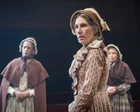
When a theatre company decides to adapt a beloved novel, they face an uphill battle. There's the shadow of previous adaptations to contend with – in this case, the 2007 BBC adaptation of Cranford that, by all accounts, threw considerable resources and sentimentality at Elizabeth Gaskell's story. Then there's the risk of being overshadowed by concurrent productions, such as the Royal Shakespeare Company's adaptation of George Eliot's Middlemarch currently running in Stratford-Upon-Avon. Yet the Orange Tree theatre's production, running until 16 January, demonstrates that what matters most is not budget or timing, but theatrical confidence and exemplary acting.
The production, co-created by Lin Coghlan, Shaun McKenna and Josh Roche, takes a refreshingly different approach. Rather than attempting to be comprehensive, the script by Coghlan and McKenna – who previously adapted The Forsyte Saga for the RSC – confidently fillets the original novel and adds new inventions without feeling either truncated or contrived. Directed by Roche, this streamlined version gets to the heart of what Gaskell's story truly offers: a portrait of women who face death, heartbreak and loss, but find strength in female friendship. That is a worthy focus, and one that deserves to be celebrated.
The casting is exemplary. Tamsin Greig's performance as Matty Jenkyns – balancing gawky comedy with a yearning for a life unlived through duty and misfortune – is sensational. She and Abigail Cruttenden, playing her sister Deborah, anchor a production led by strong women both as characters and performers. Phoebe Pryce brings moral conviction to Eliza Cleghorn, the Manchester visitor who replaces Gaskell's Mary Smith, while Sara Crowe delivers naively comic moments as Mrs Forrester and Alexandra Gilbreath brings gossipy charm as Miss Pole.
The production design deserves particular praise. Natalie Johnson's set is elegant and economical – curtains swish down for a trip to the magic show, chairs form circles for card-playing scenes – while Jamie Platt's emotional lighting and the Orange Tree's in-the-round configuration create genuine intimacy. This is theatre that trusts its audience and its performers.
What makes this Cranford essential viewing is its perfect balance between sentiment, humour and private pain. The latter two elements prevent the production from becoming mawkish, creating instead something genuinely moving. This is how classics should be adapted: with boldness, intelligence, and respect for what makes them endure. The Orange Tree has delivered a delightful surprise, and a must-see for the festive season.